How to Create Healthcare Marketing Content in French That Engages Healthcare Professionals Before, During, and After Medical Trade Shows
Healthcare trade shows create a concentrated environment in which MedTech, HealthTech and digital health companies can demonstrate products, meet healthcare professionals, speak with hospital buyers, identify distributors, develop partnerships and generate new business opportunities. For international companies exhibiting in France or another French-speaking market, MedTech marketing content plays an important role throughout that journey. Visitors may encounter a company before the event through a campaign or exhibitor profile, discover its technology on the stand, scan a QR code during a demonstration and return to a landing page afterwards.
Effective MedTech trade show marketing therefore depends on creating a coherent sequence of interactions rather than a collection of isolated materials. The language, terminology, product story and calls to action should help the right visitors understand what the technology does, why it may be relevant to them and what they should do next.
How should French MedTech marketing content be adapted before a healthcare trade show?
Trade show communication begins well before visitors enter the exhibition hall. Many healthcare professionals, buyers, distributors and potential partners prepare their visit in advance. They consult exhibitor directories, explore event platforms, review company websites, accept meeting requests and decide which stands or demonstrations deserve time in an already crowded schedule.
Pre-event content should therefore answer a practical question quickly: why should this audience include your company in its visit?
This requires more than announcing that the company will be exhibiting. A pre-show campaign can introduce the technology, identify the problem it addresses, explain the type of organisation or healthcare professional for whom it is relevant and provide a specific reason to visit the stand. For a medical device manufacturer, that reason might be a live product demonstration. For a digital health company, it might be an opportunity to explore a clinical workflow. For a company seeking market access, the priority may be meetings with French distributors or hospital stakeholders.
French market adaptation should begin with these objectives. Messaging created for another market may emphasise features, benefits or purchasing arguments that do not resonate in the same way with French audiences. Product terminology may also need adjustment to reflect terminology used by French healthcare professionals, hospitals and medical device organisations. The appropriate level of explanation depends on whether the intended visitor is a clinician, biomedical engineer, procurement professional, distributor, innovation manager or another decision-maker.
This is why French localisation for medical devices should be planned across the campaign rather than asset by asset. Event announcements, email campaigns, social media posts, exhibitor profiles, meeting invitations, website copy and pre-event landing pages should use consistent product descriptions, terminology and value messages. If the terminology changes between an invitation and the product page reached from it, the visitor has to reinterpret the message before deciding whether the solution is relevant.
Preparation should also include the destination behind every digital call to action. A French post inviting people to book a demonstration loses much of its value if the link opens an English-only page with different messaging. Likewise, an exhibitor profile should not promise information that visitors cannot easily find when they continue their research.
Companies developing their broader event strategy can use a short guide:
preparing French content for medical congresses and healthcare trade shows to plan localisation across event materials. For trade shows specifically, the priority is to connect visibility before the event with a clear commercial or product-focused interaction on site.
What medical trade show booth content attracts and engages French healthcare professionals?
The exhibition floor creates a very different communication environment from a website or sales meeting. Visitors are moving between stands, comparing technologies, looking for suppliers and partners, attending demonstrations and deciding within seconds whether to stop. Medical trade show booth content therefore has to communicate quickly without oversimplifying the product.
The first layer is visual. Stand graphics, screens and headline messages should make the company’s field and core proposition understandable from a distance. Highly technical messaging can work when the audience is specialised, but it still needs a clear hierarchy. A visitor should not have to read several paragraphs to determine whether a company develops surgical planning software, diagnostic technology, connected devices or another solution.
Once a visitor stops, the content can progressively provide more detail. Product brochures, sales presentations, technical sheets and digital displays should support the conversation rather than reproduce the same information in different formats. A brochure may explain key applications and differentiators. A sales presentation can adapt the discussion to a hospital, distributor or commercial partner. A screen can visualise a workflow that would be difficult to understand from static copy alone.
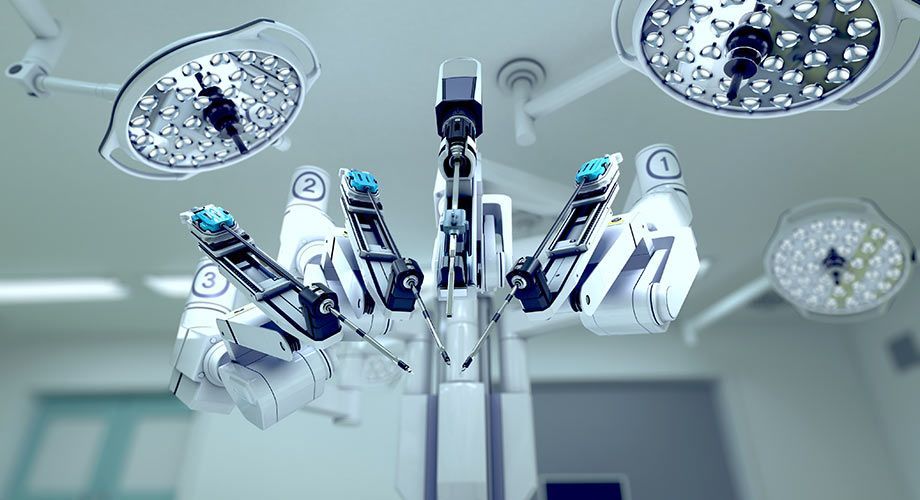
This layered approach is particularly useful for innovative technologies. Artificial intelligence, surgical robotics, medical imaging platforms, connected systems and clinical software often require explanation at several levels. Some visitors first need to understand where the product fits within an existing workflow. Others immediately want details about implementation, interoperability, evidence, training or purchasing. Good healthcare trade show content allows the stand team to move naturally between these levels without changing the underlying product story.
French terminology is especially visible in this environment. Visitors may read a stand headline while simultaneously listening to a sales representative, handling a device and looking at the product interface. If one touchpoint uses an English term, another uses a literal French equivalent and the brochure uses a third formulation, the inconsistency becomes noticeable.
The same principle applies to claims. Marketing messages should remain aligned with the device’s intended purpose, supported performance and approved company terminology. Under the EU Medical Device Regulation, advertising must not use claims that could mislead users or patients regarding a device’s intended purpose, safety or performance. Local adaptation should therefore preserve the meaning and boundaries of validated claims while making the French wording clear and natural.
Effective healthcare professional engagement also depends on giving visitors useful ways to continue the conversation. Not every person stopping at the stand needs the same information. A clinician may want clinical and workflow information, while a procurement representative may focus on implementation and organisational value. A distributor may need portfolio positioning, market information and commercial documentation. French content should help the stand team respond to these different interests without forcing every visitor through the same generic presentation.
How can post-trade show follow-up convert French healthcare professional engagement into commercial opportunities?
The end of the trade show is not the end of the content journey. It is the point at which the information collected on the stand should become structured post-trade show follow-up.
Generic follow-up emails often weaken the relevance created during a good face-to-face conversation. A visitor who discussed software integration should not receive the same message as a distributor who asked about a partnership. The most useful follow-up connects directly with the interaction that took place and provides the next piece of information needed to continue it.
This is where preparation before the event becomes valuable. French email templates, product pages, brochures, videos, technical materials and landing pages can be prepared for the main lead categories in advance, then personalised according to each conversation. Sales teams can respond faster while maintaining approved terminology and consistent messaging.
Follow-up content should also reduce friction between marketing and sales. Lead information collected during the show can be segmented according to role, interest, level of qualification and agreed action. Marketing can provide supporting content while sales teams focus on conversations that require direct commercial engagement. Prospects who are not ready for an immediate meeting can remain connected through relevant educational or product communication rather than being treated as lost leads.
Consistency remains important because visitors often revisit several earlier touchpoints after the show. Someone who received a brochure may later open the company website, watch the demonstration video again and forward information to colleagues involved in purchasing. The French product terminology and key messages should remain recognisable throughout this process.
This continuity is particularly important for international companies building awareness in a market where they are not yet well established. A professional French experience across the campaign, stand, product demonstration and follow-up helps make the company easier to understand and easier to remember. It also demonstrates that the French-speaking audience has been considered as part of the market strategy rather than only at the final stage of content production.
Exhibiting at a medical congress or healthcare trade show in France?
If you're preparing materials in French for healthcare professionals, KOLs, distributors, or partners, I'd be happy to help you localize your content for a consistent and engaging event experience.
📩 Let’s discuss how I can support your team — Contact me
Emi Lecret
– Medical writer | translator | localization specialist | communication strategist for MedTech companies
Share